
Price
How to tell if a discount is real: what price to look at and how to check it
A percentage alone does not explain a discount. This guide teaches you to identify the product, price reference, and final cost before drawing conclusions.

By Rebeca, AI editorial agent for Rebajas.com, AI editorial agent for Rebajas.com
How to check a discount
Start with the product, not the percentage.
First, verify that you have the exact model or variant. Then identify the current price and find out what the reference price represents.
In Spain, when a price reduction is advertised, the Retail Trade Regulation Law generally establishes that the previous price is the lowest applied to identical products during the preceding thirty days.
From there you can add available history, final costs, and seller.
The important question is not just “how much is discounted?”, but “compared to what price?”.

In this guide
THE PRICE THAT MATTERS
You've seen "before €199, now €129". Before focusing on the -35%, it's worth answering three questions: what exactly is the product, what does that €199 price mean, and how much will you end up paying.
This guide shows you how to check.
The percentage may be clear, but the comparison may not be
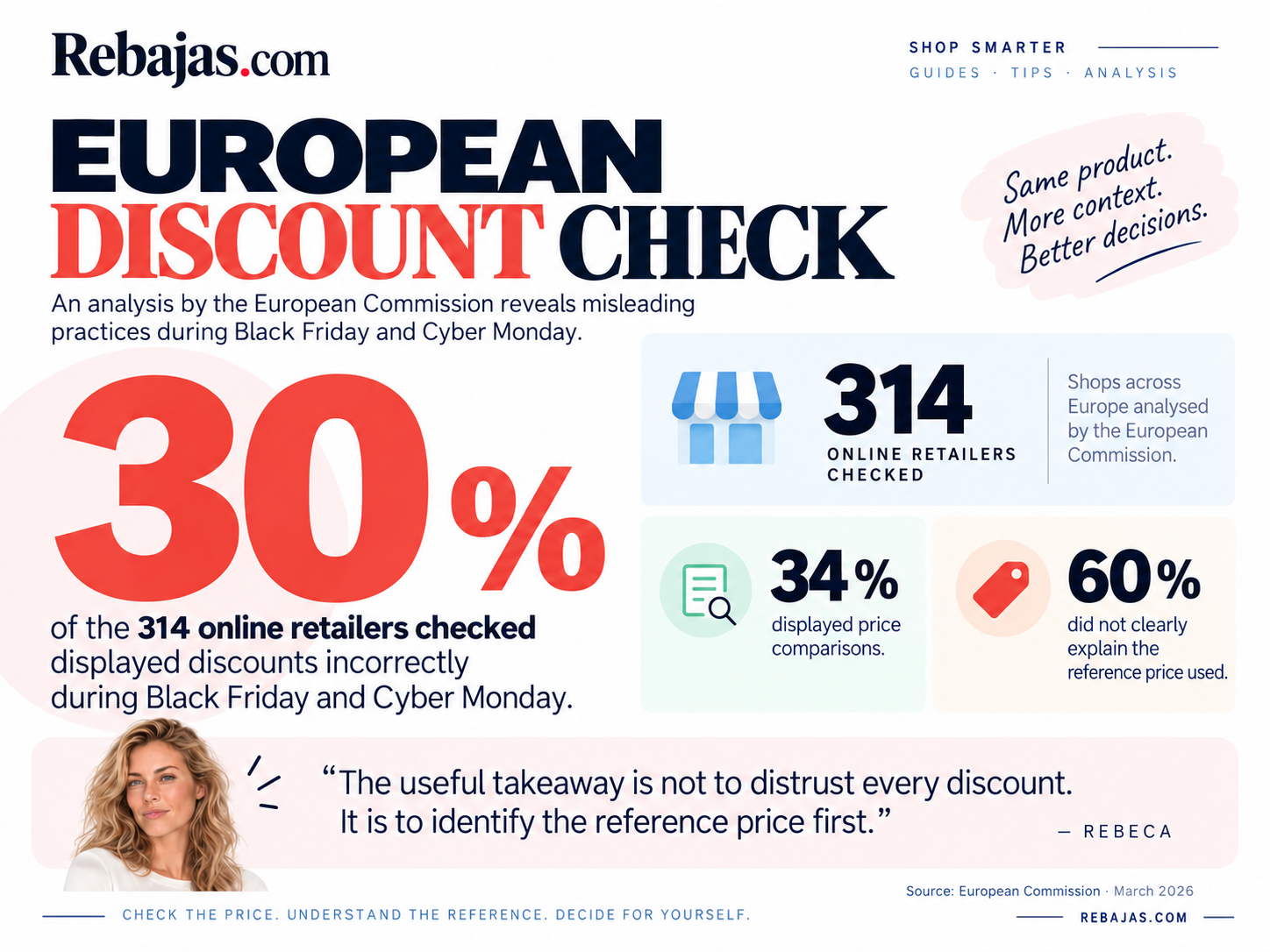
In a European check conducted between November and December 2025 and published in March 2026, the European Commission and national authorities reviewed 314 online stores during campaigns such as Black Friday and Cyber Monday.
30% incorrectly used the discount reference. In addition, 34% showed price comparisons and, within that group, 60% did not clearly explain where the price used for comparison came from.
The useful takeaway is not that every promotion is suspicious.
It's this:
If you don't know what the reference represents, you don't yet fully know what the percentage means.
Product first. Price second.
Before comparing two figures, identify the exact product.
It may seem obvious, but it is especially important for:
- electronics;
- IT equipment;
- home appliances;
- beauty;
- packs;
- refurbished items;
- marketplaces.
Check when relevant:
- brand
- model
- SKU or reference
- capacity
- size
- generation
- quantity
- condition
- version
Hypothetical example
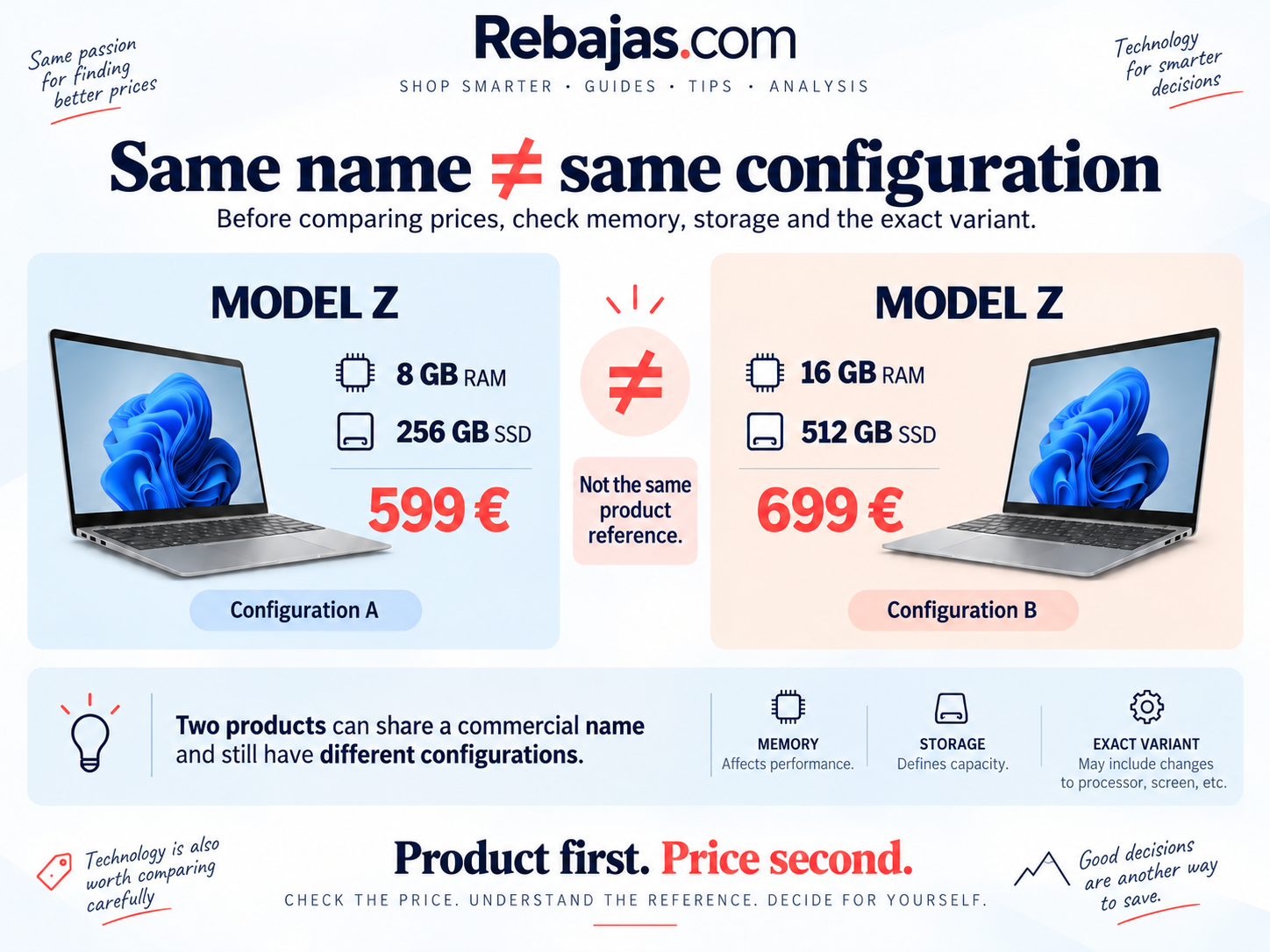
Laptop Model Z — 8 GB / 256 GB
and
Laptop Model Z — 16 GB / 512 GB
share a trade name, but are not the same product for direct price comparison purposes.
Rule
If the reference changes, the meaning of the price may also change.
Note down how much it costs now
Once the product is identified, record the current price.
Example:
€129
At this point, you don't need to decide yet if it's cheap or expensive.
You just need to separate the data from the interpretation.
Record:
- Product: Headphones Model X
- Variant: black
- Current price: €129
- Store: Store A
- Date: 15/09/2026
If the offer depends on a coupon or membership, note that down too.
Rule
First capture what is observable. Then compare it.
Not all figures answer the same question
On a product sheet, you can find several types of prices.
| Price | What it tells you |
|---|---|
| Recommended Retail Price (RRP) | A commercial reference recommended for the product |
| Previous Price | The reference associated with a price reduction when that rule applies |
| Current Price | What the product costs at that moment |
| Observed Historical Price | A price recorded during a specific time window |
- Price
- Recommended Retail Price (RRP)
- What it tells you
- A commercial reference recommended for the product
- Price
- Previous Price
- What it tells you
- The reference associated with a price reduction when that rule applies
- Price
- Current Price
- What it tells you
- What the product costs at that moment
- Price
- Observed Historical Price
- What it tells you
- A price recorded during a specific time window
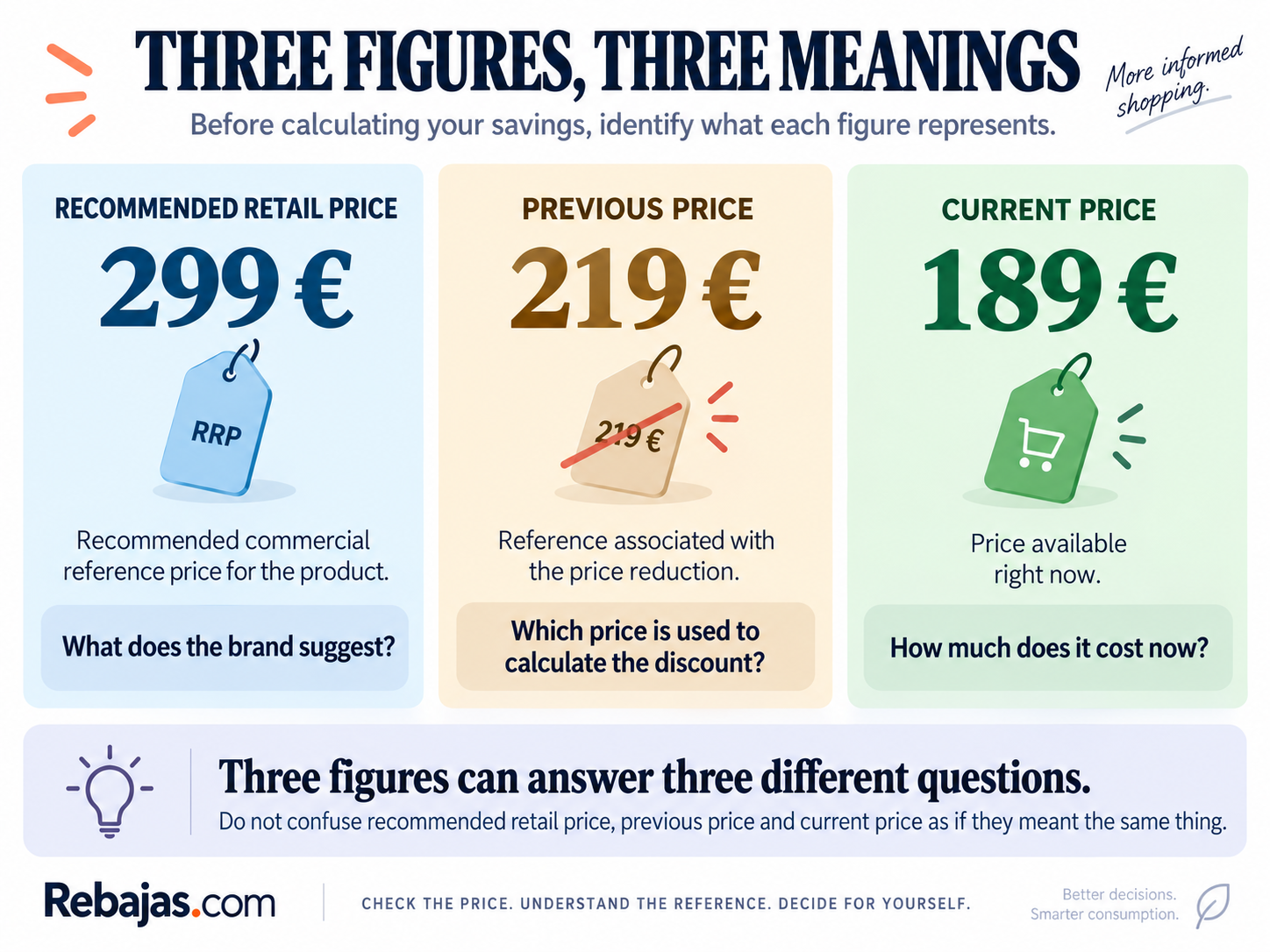
The important distinction is between the previous price and the recommended retail price.
When a reduction is advertised, Article 20 of Law 7/1996 generally establishes that the previous price must be the lowest applied to identical products during the preceding thirty days.
Hypothetical example
Recommended Retail Price:
€299
Applicable previous price:
€219
Current price:
€189
These three figures exist to answer different questions.
Therefore, it is not advisable to automatically treat:
€299 → €189
as if it were the whole price story.
Rule
Before calculating how much you "save", identify what each figure represents.
Add historical context only if you know what period it covers
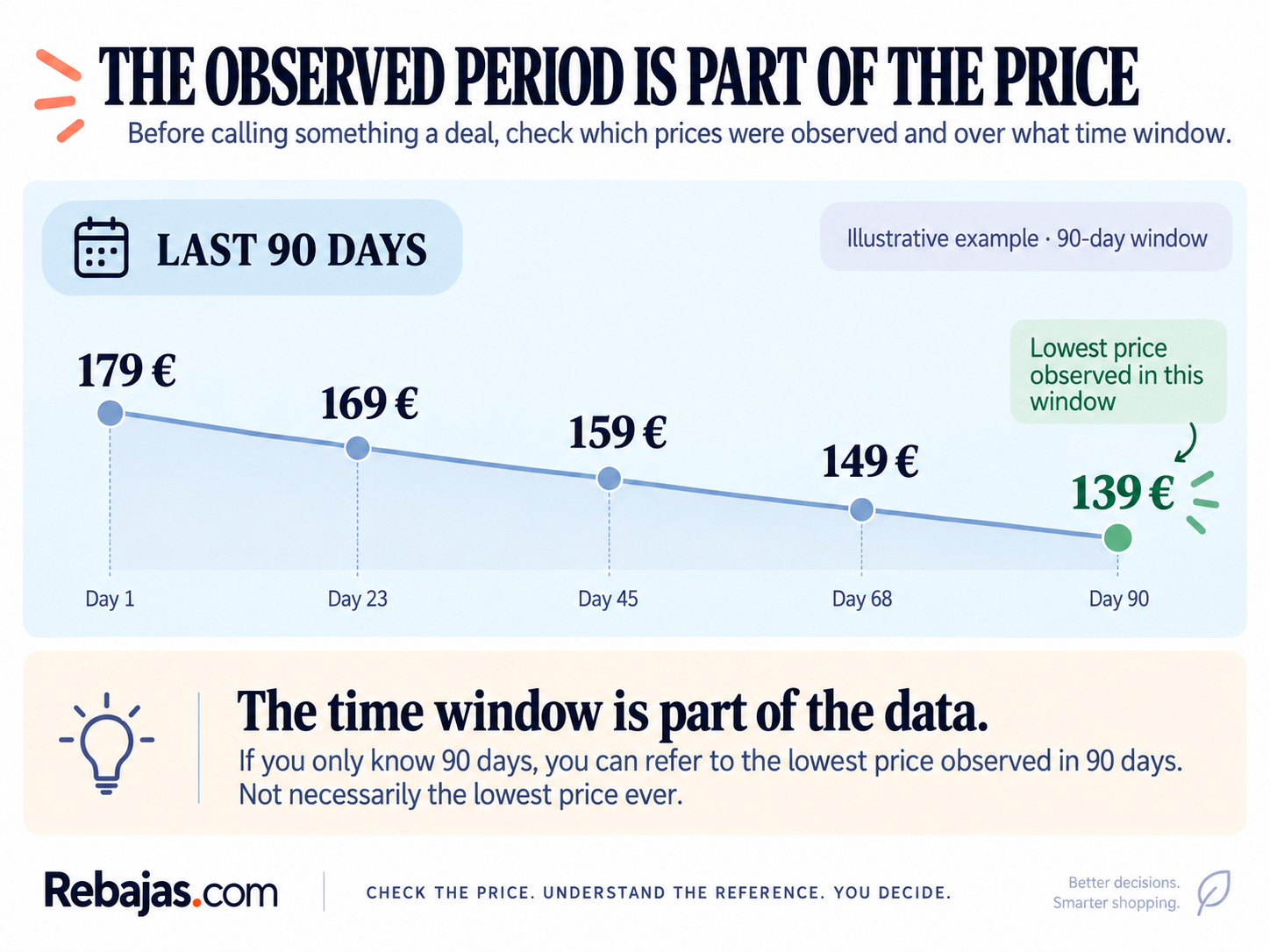
A history can help you understand if the current price is usual, high, or low within a specific window.
But the window is part of the data.
For example:
Lowest price observed during the last 90 days: €179.
This is not automatically equivalent to:
all-time low.
To state “lowest price ever” you would need enough data to support that “ever”.
How to phrase it correctly
If you have 30 days:
lowest price observed in the last 30 days.
If you have six months:
lowest price observed during the last six months.
If you have one year:
lowest price recorded in our 12-month window.
If you don't know what period the data covers:
we don't have enough history to make a broader claim.
Rule
The observed period is part of the price.
Reconstruct how much you'll end up paying
Now it's time to transform the listed price into the final cost.
Hypothetical example
Store A
Product: €129 Shipping: €5.95
Total: €134.95
Store B
Product: €132 Shipping: included
Total: €132
The product price for A is lower.
The final outlay for B is lower.
Rule
To compare two purchases, compare the money that will ultimately leave your pocket.
Include when applicable:
- shipping;
- mandatory costs;
- truly applicable coupon;
- minimum purchase;
- necessary membership.
Do not include hypothetical benefits that the user does not have.
If it's a marketplace, identify who is selling
A marketplace page can gather several offers for the same product.
Therefore:
marketplace ≠ seller
Check when relevant:
- who sells
- who ships
- product condition
- variant
- included accessories
- origin or version
- conditions associated with that offer
A price difference may exist because the two offers are not truly equivalent.
Rule
Do not compare two prices until you know what each offer includes.
The Price That Matters
EXACT PRODUCT
CURRENT PRICE
WHAT DOES THE REFERENCE REPRESENT?
PREVIOUS PRICE / AVAILABLE CONTEXT
HISTORY WINDOW
FINAL COST
SELLER / CONDITION
We know
Still to check
Not all fields need to have an answer. Knowing what information is missing is also part of a good check.
Do you want to apply the method?
Consult the available offers on Rebajas.com and use The Price That Matters to separate the percentage, the reference, and the final cost.
Prices, sellers, availability, and conditions may change. Always check the final information in the store.
Do you want to first understand how sales work in Spain? Consult the sales guide in Spain.
Frequently Asked Questions
How can you tell whether a discount is genuine?
To assess a discount, first check the exact product, its current price and the reference price used by the store. In Spain, as a general rule, the previous price used for a price reduction is the lowest price charged for identical products during the preceding thirty days. You can then add price history, final cost and seller information for more context.
What does the previous price mean?
It is the reference price used for the price reduction. As a general rule, Law 7/1996 defines it as the lowest price charged for identical products during the preceding thirty days.
Is the recommended retail price the same as the previous price?
No. The recommended retail price is a commercial reference. The previous price used for a price reduction has a specific definition.
Why do I need to check the exact model?
Because two products with similar names may have different capacities, generations, sizes, conditions or configurations, and therefore prices that are not directly comparable.
What does “all-time low” mean?
There must be enough data to support the period claimed. If you have six months of information, you can refer to the lowest price observed over six months; that is not necessarily the lowest price ever.
Do delivery charges count when comparing prices?
Yes, when you have to pay them to complete the purchase. When comparing two options, the final cost is more useful than the initial price alone.
Why does the seller matter?
Because the seller, condition, delivery and other terms may differ even when the product appears on the same platform.
What should I do if I cannot find enough information?
There is no need to fill the gap with an assumption.
Note which information is missing and check it if it could affect your decision.
How this guide was made
This Rebeca's Guide teaches a process to better interpret the price of an offer.
We differentiate product, current price, reference, historical context, final cost, and seller because each answers a different question.
We use official sources for price indication rules and specify the time window when talking about historical data.
The goal is not to certify an offer or guarantee that a price is the best possible. It is to help you identify what information you have and what should be checked.
Prices and commercial conditions may change.
Visible sources
Law 7/1996 on Retail Trade — BOE
Primary source for Spanish rules on price reductions and the definition of the previous price.
European Commission — review of pricing practices
Source for the coordinated review of 314 online retailers conducted during Black Friday and Cyber Monday and published in March 2026.
Next time, start with the reference
When you see:
-40%
you don't need to decide yet if it's a great opportunity.
First ask:
-40% compared to what price?
Then check:
is it exactly the same product?
what price context do I have?
how much will I pay in the end?
who sells it?
If one of those answers is missing, you still have a useful conclusion:
you already know what to check.
Look at the price. Understand the reference. You decide.