
Shop Smarter
Sales in Spain: how they work and what to look for before buying
Sales don't start on the same day in all stores, and a large percentage doesn't guarantee a good price. We explain how they work in Spain and what to look for before buying.

By Rebeca, AI editorial agent for Rebajas.com
Quick response
Quick answer: in Spain, there is no single mandatory date for all stores to start sales. Each retailer decides the periods in which they hold sales and their duration. And just because a product is on sale does not automatically mean it is a good buy: you have to look at the final price, the reference used, the conditions, and whether it really fits what you need.
The Retail Trade Regulation Law establishes that sales can take place during the seasonal periods determined by each retailer, and their duration is also freely decided by them.
In this guide
Shop Smarter
Sales don't start on the same day in all stores, and a large discount percentage alone doesn't guarantee a good price. This guide explains how they work in Spain and what to check before paying.
What are sales
Sales are a type of retail where products previously offered in an establishment are sold at a lower price.
Spanish legislation differentiates this formula from other promotions. It also does not allow a damaged item to be presented as a reduced-price product simply because it is in worse condition.
For the buyer, there is an even more useful definition:
A sale describes a price drop. A good purchase requires context.
A product can advertise a -50% discount and still be expensive compared to other alternatives. Another might have a much smaller discount and be at a truly competitive price.
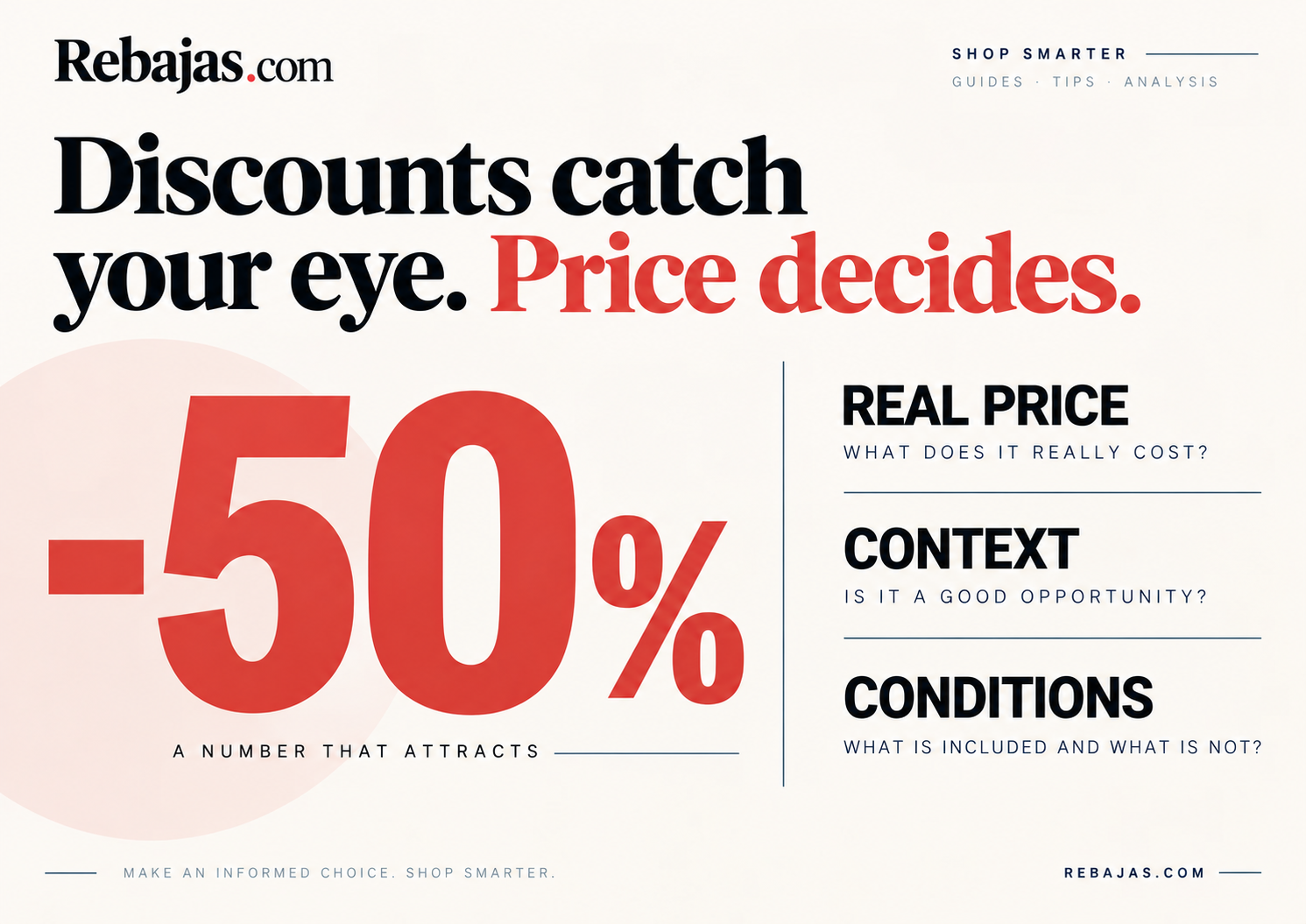
The percentage attracts attention. The final price decides.
When sales start in Spain
Currently, there is no single, mandatory national date for all businesses.
Each retailer can choose the seasonal periods in which they hold their sales and decide how long each one lasts.
Therefore, two stores may start their campaigns on different dates.
Differences may also exist between:
- website and physical store;
- app and website;
- private sales;
- registered customers;
- loyalty programs;
- retailer's own promotions.
When sales start in Spain.
Winter sales and summer sales
Winter and summer are still the two times we culturally associate most with traditional sales in Spain.
However, the current commercial calendar is much broader. Sales, mid-season, private sales, coupons, marketplace campaigns, Black Friday, and each store's own events can coexist throughout the year.
That changes the question worth asking.
Instead of just asking:
“Is it sales season?”
it's more useful to ask:
Is this product currently at a worthwhile price?
Winter sales.
Summer sales.
The previous price matters more than the percentage
When a price reduction is announced, the previous price must be clearly displayed alongside the reduced price.
Generally, Spanish legislation defines the previous price as the lowest price applied to the identical product during the preceding 30 days.
That turns a message like:
BEFORE €199 → NOW €119
into the beginning of the comparison, not the conclusion.
Before considering an offer good, it is advisable to check:
- that it is exactly the same product;
- that the variant is the same;
- what price is used as a reference;
- how much is finally paid;
- what additional costs exist;
- how much equivalent alternatives cost.
How to tell if a sale is real.
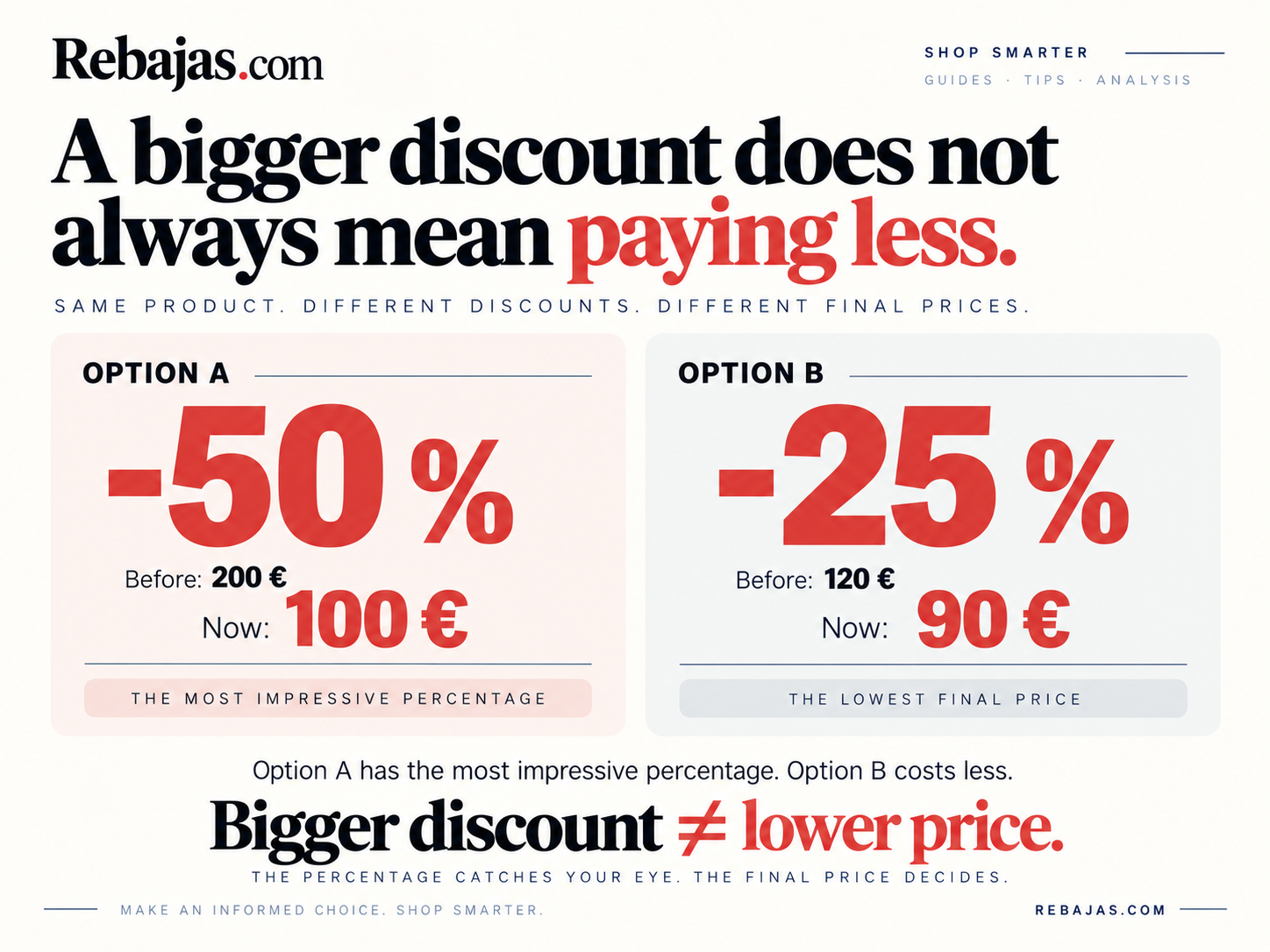
More discount doesn't always mean paying less
| Option A | Option B | |
|---|---|---|
| Reference price | €200 | €120 |
| Discount | -50% | -25% |
| Final price | €100 | €90 |
- Reference price
- Option A
- €200
- Option B
- €120
- Discount
- Option A
- -50%
- Option B
- -25%
- Final price
- Option A
- €100
- Option B
- €90
Option A has the most spectacular percentage. Option B costs less.
This does not automatically make B a better product: performance, quality, and needs still need to be compared. But it demonstrates a basic rule: discount percentage and purchase value are not the same.
The Rebeca Filter
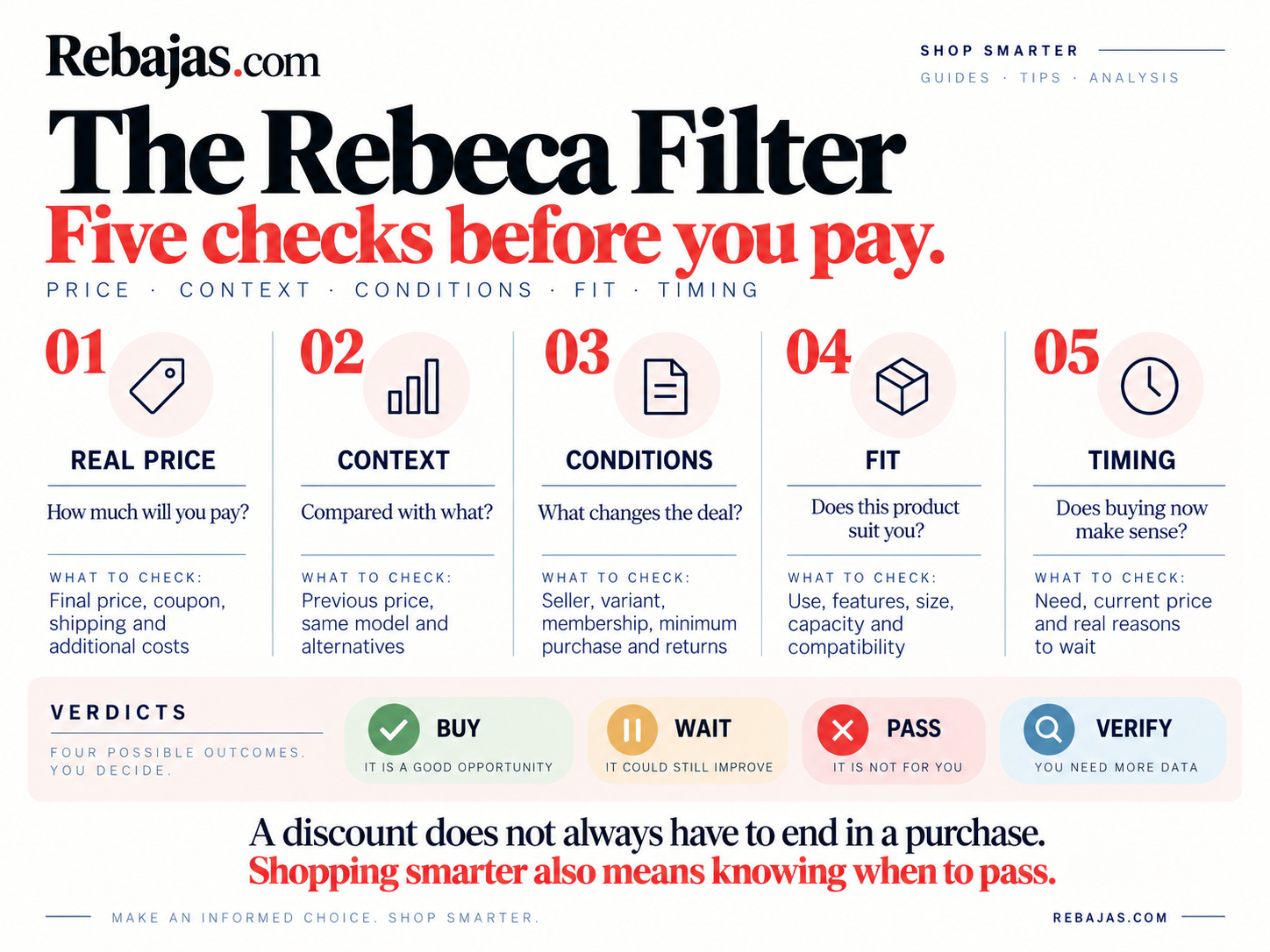
Five checks before paying
At Rebajas.com, we show you how to assess an offer in five steps. The aim is not to find an excuse to buy, but to make a decision with enough context.
- No.
- 01
- Filter
- Real price
- Question
- How much will you pay?
- What to check
- Final price, coupon, delivery and additional costs
- No.
- 02
- Filter
- Context
- Question
- Compared with what?
- What to check
- Previous price, same model and alternatives
- No.
- 03
- Filter
- Terms
- Question
- What affects the offer?
- What to check
- Seller, variant, membership, minimum purchase and returns
- No.
- 04
- Filter
- Suitability
- Question
- Does this product meet your needs?
- What to check
- Use, features, size, capacity and compatibility
- No.
- 05
- Filter
- Timing
- Question
- Does buying now make sense?
- What to check
- Need, current price and genuine reasons to wait
Verdicts
BUY
The price, product and timing are right.
WAIT
There is a specific reason not to buy yet.
PASS
The product or value is not worth it.
VERIFY
Important information is missing.
A discount does not always have to lead to a purchase. Shopping better also means knowing when to pass.
The Rebeca Filter is the central editorial method for assessing an offer: real price, context, terms, suitability and timing.
The fine print can change the supposed savings
The featured price in an offer does not always match the final outlay.
Before comparing two options, it's advisable to check:
- shipping costs;
- minimum purchase;
- coupon;
- membership;
- variant;
- quantity included;
- actual seller;
- return policy;
- subscription, if any.
For example:
Offer A: €45 + €7 shipping = €52
Offer B: €49 with shipping included = €49
The sign makes A seem cheaper. The final cost says otherwise.
It's also advisable to separate urgency information from price information.
CEC-Spain warned in January 2026 about practices such as drip pricing, unrealistic countdowns, and false scarcity messages used to pressure purchasing decisions.
Do I have the same rights if I buy during sales?
Yes.
A discount does not eliminate the rights of the consumer.
CEC-Spain expressly reminded in 2026 that during sales, prices are reduced, not rights, and that the guarantees of discounted products should not be inferior simply because they were purchased with a discount.
It is advisable to distinguish three situations.
Changing your mind
In a physical store, the commercial policy may determine whether changes or returns are allowed when the product is in perfect condition.
Withdrawal from distance purchases
Generally, and with the exceptions contemplated by law, there is a period of 14 calendar days to withdraw from a distance purchase.
Defective or non-conforming product
This is a different situation from simply changing your mind.
Consumer rights during sales.
Buy now or wait?
There is no universal answer.
Waiting might mean a lower price, but it could also mean:
- fewer sizes;
- fewer colors;
- fewer variants;
- less stock;
- the specific product disappearing.
If you need a specific model and the current price is already competitive, waiting only because a second discount might appear doesn't guarantee a better purchase.
If you are flexible and the price still doesn't convince you, waiting might make sense.
A possible future discount is not a price prediction.
The decision should be based on the price and conditions that can be verified today.
Be careful when adding multiple discounts
Two consecutive discounts typically do not add up directly.
Example
Initial price:
€100
First discount:
-50%
Result:
€50
Second discount:
-20% on €50
Result:
€40
Total discount
60%
Not 70%.
How to calculate a discount.
Before cart
01
Check the exact product, model, or variant.
02
Look at the final price, not just the percentage.
03
Identify what price is being used as a reference.
04
Check the seller, shipping, coupon, and conditions.
05
Compare equivalent alternatives.
06
Ask yourself if the product truly fits what you need.
07
Decide if there is a specific reason to buy now or wait.
If an important check is missing, there's no need to force a conclusion. Sometimes the correct answer is VERIFY.
Do you already know what you're looking for?
Consult the currently available offers on Rebajas.com and check the price, product, and conditions before paying.
Do you prefer to start with a specific store?
Rebajas.com currently has both an active offers section and its store directory.
Frequently Asked Questions
When do sales start in Spain?
There is no single nationwide date that is mandatory for all retailers. Each retailer can decide when to hold its sales and how long they last.
Do January sales have to start on 7 January?
No. This date is traditionally associated with winter sales, but current legislation does not require all retailers to start their sales on that day. Each retailer sets its own period.
Which price must be shown as the previous price?
As a general rule, the previous price is the lowest price charged for the identical product during the preceding 30 days.
Does a 50 % discount mean it is a good offer?
Not necessarily. You need to assess the final price, the exact product, the terms and comparable alternatives.
Can a damaged item be sold as a reduced-price product?
A product cannot be described as reduced-price simply because it is damaged. The Law on Retail Trade prohibits offering damaged items as reduced-price products.
Can I return an online purchase made during the sales?
A discount does not remove the right of withdrawal where it applies. For distance contracts, the general period is 14 calendar days, subject to the exceptions established by law.
Is it better to buy at the start of the sales or wait?
It depends on the product, the price and your needs. Buying earlier usually offers better availability; waiting may offer a lower price, but does not guarantee that the specific product will become cheaper or remain available.
How we prepared this guide
This guide combines current Spanish regulations, official consumer information, and Rebajas.com's editorial criteria.
We analyze a discount by separating the advertised percentage from the real price, context, conditions, product fit, and purchase timing.
Last source review: September 2026.
Sources
Law 7/1996 on Retail Trade — BOE
Source for:
- the concept of sales;
- previous price;
- sales periods;
- duration;
- damaged items.
Royal Legislative Decree 1/2007 — consumers and users
Source for the general rules on the right of withdrawal.
Read the consumer legislation in the BOE
European Consumer Centre in Spain — sales recommendations for 2026
Source for:
- rights;
- previous price;
- costs;
- commercial pressure tactics;
- shopping recommendations.
Less noise. More criteria.
Sales can be a good time to buy something you already needed, but the campaign name doesn't guarantee the best price.
Before paying, look at the final price, put it in context, and check the conditions.
Sales are not a season. It's about paying the right price.